

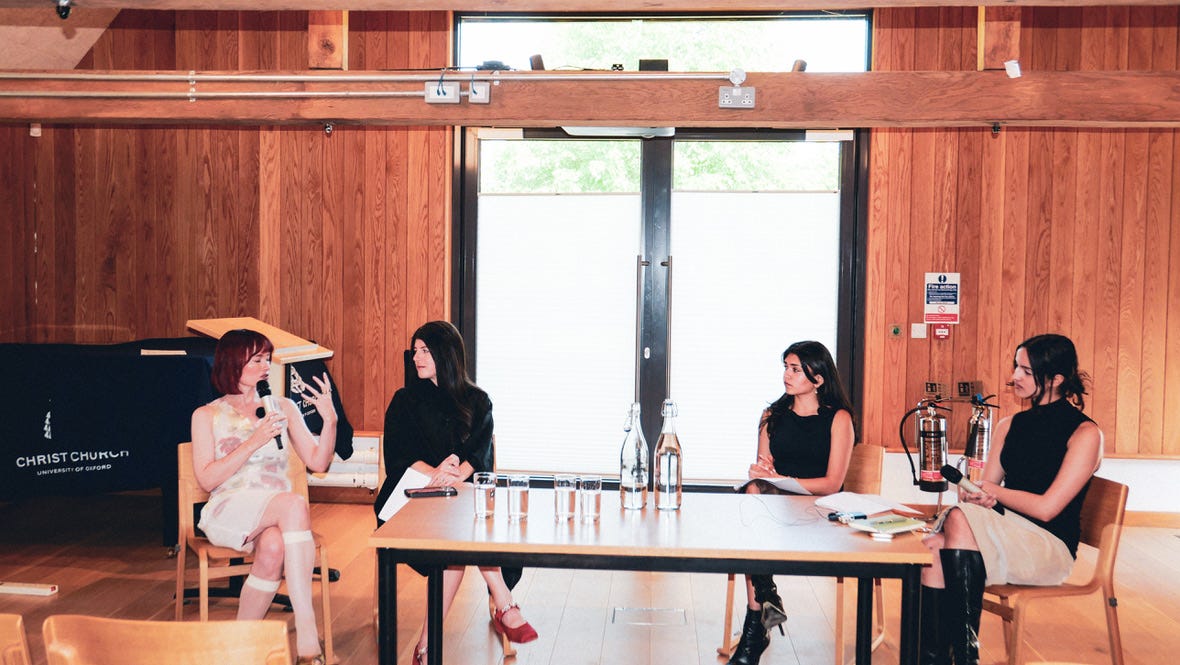
On the 8th of May, Christ Church played host to an evening that proved fashion’s most compelling conversations happen far beyond the runway
There is a particular kind of authority that exists in fashion, one that has nothing to do with a front row seat or a lanyard, and everything to do with the accumulated weight of a career built on instinct, relationships, and an almost pathological commitment to the craft. On the evening of May 8th, 2026, that authority settled comfortably into Christ Church’s research centre in the form of two women who, between them, have shaped the image of British fashion from entirely different sides of the industry.
Julia Hobbs, British Vogue’s Senior Contributing Fashion Features Editor, and Daisy Hoppen, founder and director of DH-PR, were the guests of the inaugural Women in Fashion panel, hosted by Oxford Fashion Society and from the moment they arrived, the visual argument alone was worth attending.
Hobbs has, over the years, cultivated a signature that is increasingly rare in an industry prone to anonymous black: she commits. Her sleek red hair, by now as recognisable a part of her professional identity as her prose, caught the light of the research centre with the kind of cheerful defiance that one associates with early Meadows, or the more whimsical corners of Molly Goddard. The outfit itself moved in the register of soft gold and blush pastel, the heels architectural, the overall effect both considered and warm. A woman who understands that dressing for your platform is its own form of editorial. Against the stone backdrop of Christ Church, she looked, frankly, like a feature.
Hoppen, by contrast, dressed with the cool precision of someone who has spent over a decade shaping how others perceive their clothes. Her black, and this is important, was not the black of indecision. It was the black of someone who represents Simone Rocha and Ganni and understands, better than most, the full communicative spectrum available within a single colour. Pared back, yes. Austere, no. She herself acknowledged the paradox with characteristic directness: that PR can render its architects invisible, that the industry has a habit of erasing the hands that build it. Her wearing black, in that context, read less as minimalism and more as a quiet, knowing refusal to disappear.
The conversation was led initially through its formal passages by Fashion Soc vice presidents Rokia and Anaiya, before the floor opened at around 6:15 pm into something more kinetic. The questions were sharp, the atmosphere generously competitive in the way only a well-assembled room of genuinely curious people can produce.
Hobbs spoke about her origins with the kind of candour that editors of her stature rarely offer so freely. The trajectory was not the obvious one: a law degree, a serious flirtation with European legal institutions, a stint at the EU Delegation to the United Nations, and then, finally, the admission that fashion had always been the point. The pivot was daunting, she said. She credits the beginning to something gloriously unassuming: a copy of Vogue, purchased alongside a pack of Juicy Fruit. From there, a fashion coordinator role at the magazine, years navigating its digital transformation, the early tremors of AI, and a career that now encompasses BBC Woman’s Hour, BBC News, and the kind of writing that makes fashion feel genuinely necessary to people who would otherwise insist it isn’t.
She noted, without self-pity but with useful clarity, that the industry she entered possessed more generous budgets and more visible entry points than the one facing graduates today. It is a contraction worth naming.
The room’s most audible moment, a collective, involuntary intake of breath, came when
Hobbs described shooting in Kate Moss’ home. In her wardrobe. With her. The Alexander McQueen baby bump on Kate’s runway, she reminded us, was not incidental iconography. It was storytelling of the highest order, the kind that only fashion can produce because, as Hobbs put it with the simplicity of someone who has spent years arriving at exactly this conclusion: fashion is human.
Hoppen, whose agency since its founding in 2013 has grown to represent Stone Island, Tekla, Belmond and Dover Street Market alongside its fashion roster, was equally plain-spoken. She would not, she said, start the business today. What she built exists because of relationships, because the fashion world is, at its core, intimate in a way that resists the facelessness of which PR is so often accused.
Both women spoke warmly and without performance about female solidarity as structural rather than sentimental. And how, despite the assumptions that AI will be homogenising journalists’ voices, we as writers and fellow fashionistas can combat this through producing our own unique points of view or niches on Substack, and how it is more powerful than ever.
A question from the floor, including one posed by yours truly on the role of politics in fashion journalism, was received by Hobbs as not merely valid but essential. Clothes, she said, do not exist outside the world that makes them. They never have.
Christ Church, for one evening, agreed.